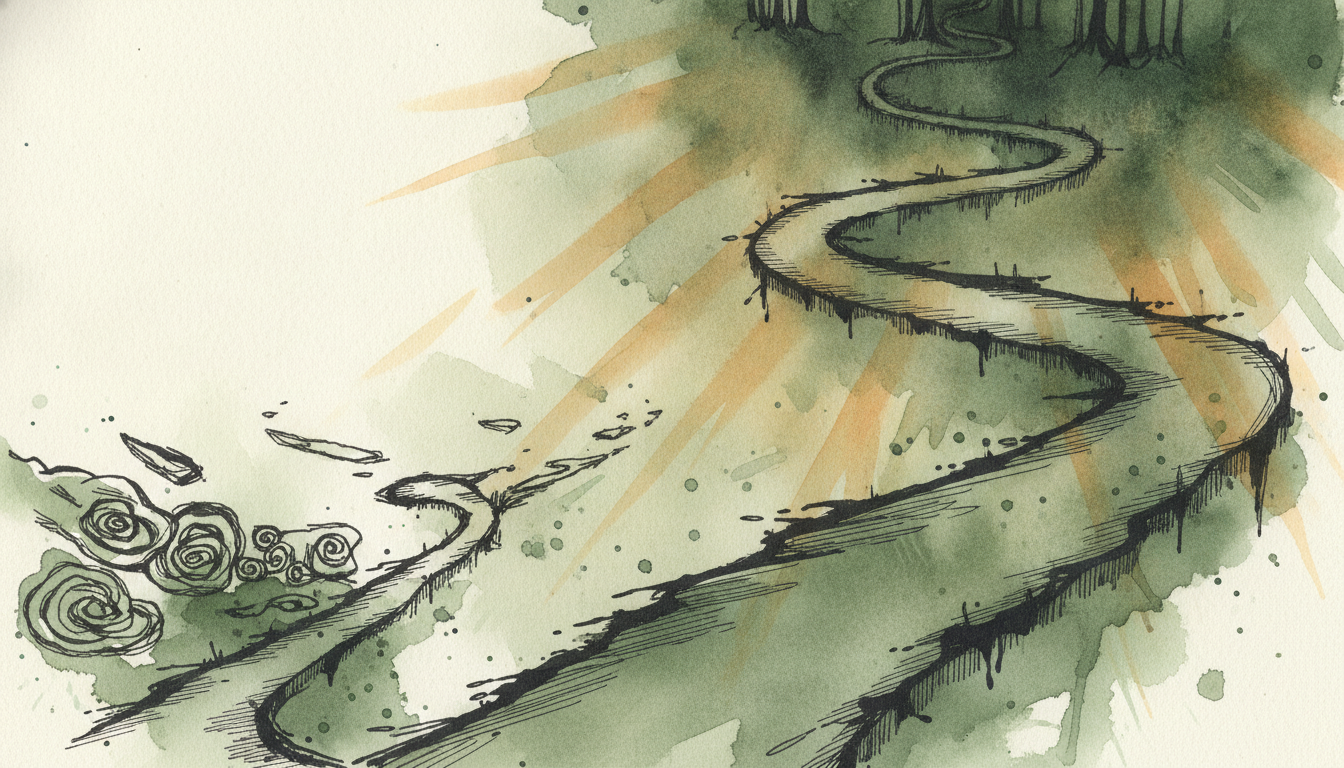
We live in an era of perpetual flux. Career paths shift unexpectedly. Relationships evolve in ways we didn't anticipate. Economic landscapes reshape themselves overnight. And now, artificial intelligence is rewriting what work even means. For many of us, the discomfort of not knowing what comes next has become a constant companion—and learning to befriend that feeling might be the most valuable skill we can develop.
Uncertainty tolerance isn't about developing nerves of steel or pretending fear doesn't exist. It's about building a genuine capacity to move forward even when the ground beneath your feet feels unstable. It's recognizing that the unknown isn't your enemy; it's simply where all possibility lives.
Key Takeaways
- Uncertainty tolerance is a learnable skill that strengthens resilience and adaptability
- Ambiguity acceptance reduces anxiety and opens pathways to creative problem-solving
- Practical strategies like mindfulness and perspective-shifting help navigate transitions
- Building comfort with the unknown creates freedom rather than fear
- Self-awareness tools can help identify your personal uncertainty triggers
Why Uncertainty Tolerance Matters Now More Than Ever
The modern world doesn't reward avoidance. Jobs that felt secure a decade ago have vanished. Relationships require ongoing renegotiation rather than fixed contracts. Even our health and personal safety involve probabilities we can't control. The old promise—"follow the rules and you'll be secure"—has been broken, and many of us are still grieving that loss.
But here's what's often missed: uncertainty tolerance isn't something only the brave possess. It's something that can be cultivated, strengthened, and refined like any other skill. People who seem remarkably calm in chaotic situations aren't born that way. They've learned to interpret ambiguity differently. They've practiced sitting with discomfort. They've discovered that not-knowing doesn't have to mean not-moving.
This skill has become essential for workplace transitions, relationship shifts, and the broader societal stress we all feel as technology reshapes what we thought we knew about our futures. The people who thrive in uncertain times aren't those with perfect plans—they're those who've learned to trust themselves within the unknown.
Understanding Ambiguity Acceptance: The Psychology Behind Comfort
Uncertainty and ambiguity are actually two sides of the same coin, though they feel different. Ambiguity means multiple interpretations are possible. Uncertainty means outcomes are unclear. Both trigger our brain's threat detection system, which evolved to keep us safe from predators but now fires up when we're simply facing a career crossroads.
When we encounter ambiguity, our mind immediately searches for pattern and closure. This is why uncertainty feels so destabilizing—our nervous system actively resists the state of open-endedness. But neuroscience has shown us something encouraging: we can train our brains to become comfortable with ambiguous stimuli.
Ambiguity acceptance doesn't mean liking chaos or abandoning planning. It means acknowledging that some variables lie outside your control, and that's okay. It means recognizing that even with incomplete information, you can still move forward with intention. When we accept ambiguity, we free up mental energy that was being consumed by resistance, and we redirect it toward creative adaptation strategies.
People with high uncertainty tolerance aren't prone to analysis paralysis. They don't need perfect information before taking the next step. This allows them to learn faster, pivot more easily, and innovate more readily. In the face of AI-era workplace shifts, or personal relationship transformations, or any major life transition, this flexibility becomes your competitive advantage.
Building Resilience Through Adaptation Strategies
Resilience doesn't mean bouncing back unchanged. It means growing stronger through difficulty. And the primary way we build resilience is by repeatedly facing manageable uncertainty, surviving it, and updating our belief about our own capability.
Here are foundational adaptation strategies:
Create small exposures. Don't dive into the deep end. If you're uncomfortable with uncertainty, start small. Make a decision with 70% of the information you want instead of waiting for 100%. Take a class in a subject you know nothing about. Say yes to a social event where you won't know everyone. Each small experience teaches your nervous system that the unknown doesn't destroy you.
Develop a relationship with contingency planning. Paradoxically, becoming comfortable with uncertainty often requires a bit of planning—not obsessive planning, but thoughtful preparation. Have a backup plan. Know what you'd do if your current path falls apart. This isn't negative thinking; it's responsible thinking. And strangely, having a Plan B often makes you more willing to commit fully to Plan A.
Practice perspective-shifting. When your mind spirals into worst-case scenarios, intentionally zoom out. "Okay, if this uncertainty persists for five years, how would I adapt?" Often, we realize we'd adapt quite well. We're more resourceful than we give ourselves credit for.
Build community around change. Navigating transitions alone amplifies anxiety. When you're experiencing uncertainty, connection becomes medicine. Share what you're uncertain about. Listen to others' stories of moving through ambiguity. You'll realize that everyone is genuinely lost sometimes, and that's not a character failure—it's the human condition.
Navigating Life Transitions With Grounded Presence
Whether you're changing careers, ending or evolving relationships, moving cities, or stepping into a new role, major life transitions are intensified periods of uncertainty. They demand something of us: the ability to stay present even when the future is unclear.
Grounded presence—the practice of anchoring awareness in what's real right now—becomes your stabilizer during transitions. When your mind is spinning with "what-ifs," you're no longer actually here. You're catastrophizing about futures that may never arrive. Grounded presence invites you back.
Mindfulness practices serve this beautifully. A daily meditation practice, even ten minutes, rewires your brain's relationship with uncertainty. It teaches you that thoughts are just thoughts, not facts. That you can observe anxiety without being controlled by it. That the present moment is actually quite manageable, even when you're uncertain about tomorrow.
Beyond formal meditation, grounded presence can be found in your body. When uncertainty rises, pause and notice: What do you feel? Where in your body do you experience the anxiety? Can you breathe into that space? This simple somatic awareness shifts you from "lost in my anxious thoughts" to "here, in this moment, I'm actually okay."
Transitions are also excellent times to practice self-compassion. You're learning and adjusting. There will be missteps. That's not failure—that's data. When you encounter a transition, bring the kindness to yourself that you'd offer a good friend navigating the same change.
Practical Exercise: Your Uncertainty Tolerance Assessment
Let's make this tangible. Take twenty minutes for this reflection:
Part One: Map your uncertainty triggers.
Write down the situations that most activate your discomfort with uncertainty. Is it professional ambiguity? Relationship unknowns? Health concerns? Financial unpredictability? Be specific.
Part Two: Rate your current tolerance.
For each trigger, rate on a scale of 1-10 how well you currently tolerate that type of uncertainty. Be honest.
Part Three: Identify small exposures.
For one trigger area where you scored lower, identify one small way you could practice tolerating ambiguity this week. Not something terrifying—something manageable.
Part Four: Notice what shifts.
After trying your small exposure, journal about what happened. Did your anxiety spike? Did it pass? What did you learn about yourself?
If you're interested in a deeper dive, consider starting with Innr's free assessment, which can help you understand your patterns around change and uncertainty more comprehensively. Understanding your specific stress responses and resilience patterns is a powerful first step toward real growth.
The Unexpected Freedom in Not Knowing
Here's what most people discover once they begin strengthening their uncertainty tolerance: freedom lives here.
When you stop fighting against uncertainty, when you accept that some things can't be controlled, an interesting paradox emerges. You actually become more effective. You take better risks because you're not paralyzed by fear. You make bolder choices because you're not waiting for perfect conditions. You remain open to opportunities you hadn't anticipated because you're not rigidly locked into one predetermined path.
The AI-era workplace, with its fluid job descriptions and shifting skill requirements, actually rewards this mindset. So do evolving relationships that require ongoing communication rather than fixed roles. So does any life path that involves actual growth rather than repetition.
Uncertainty isn't something to eventually overcome and leave behind. It's a permanent feature of being alive, especially now. But learning to navigate it, to breathe within it, to even find creative possibility in it—that's the skill that makes all the difference. That's what transforms uncertainty from a source of dread into a companion on the journey.
FAQ: Your Questions About Uncertainty Tolerance Answered
Is uncertainty tolerance the same as being indecisive?
Not at all. In fact, they're nearly opposite. High uncertainty tolerance allows you to make decisions despite incomplete information. Indecisiveness is being paralyzed by incomplete information. Someone with strong uncertainty tolerance can say, "I don't know everything about this situation, but here's my best decision with what I know now," and then move forward. That's decisive.
Can I build uncertainty tolerance if I have anxiety?
Absolutely. In fact, anxiety is often a sign that you've been avoiding uncertainty rather than practicing with it. Building tolerance is actually therapeutic for anxiety. By deliberately practicing small exposures to manageable uncertainty, you're teaching your nervous system that you can handle more than it thinks. Anxiety decreases through gradual exposure, not avoidance.
What's the difference between accepting uncertainty and giving up on planning?
Healthy acceptance of uncertainty enhances planning rather than replacing it. You plan for what you can control and influence, and you accept what you cannot. You prepare backup plans and contingencies, but you don't let incomplete information prevent you from choosing a direction. It's planning with open hands rather than rigid ones.
How long does it take to develop stronger uncertainty tolerance?
Like most skills, you'll notice shifts within weeks if you're practicing intentionally. Small exposures compound. However, true resilience—the ability to handle major life transitions—develops over years and through actual experience of navigating significant change. Be patient with yourself. Every moment of choosing presence over panic is progress.
How does uncertainty tolerance relate to self-awareness?
They're deeply connected. If you don't know your specific triggers, your nervous system patterns, or your habitual responses to discomfort, you're working blind. Self-awareness is the foundation. Once you understand how you specifically experience and process uncertainty, you can design better strategies. That's why tools like Innr's free assessment can be so valuable—they illuminate your patterns so you can work with them intentionally rather than just reacting automatically.
The future will continue to be uncertain. Your job, your relationships, your health, your place in a rapidly changing world—none of these are guaranteed static conditions. But you have something far more reliable than certainty: you have the capacity to learn, adapt, and grow. That capacity strengthens every time you choose presence over panic, acceptance over resistance, and forward movement despite ambiguity.
The question isn't whether you can avoid uncertainty. The question is: will you learn to move through it with grace?